GB3608-2025 will be mandatory effective on May 1, 2026 (next month). This represents not merely a standard update, but a watershed moment when high-altitude work management transitions from "reference requirements" to "mandatory regulations"—leaving enterprises less than one month to adjust.
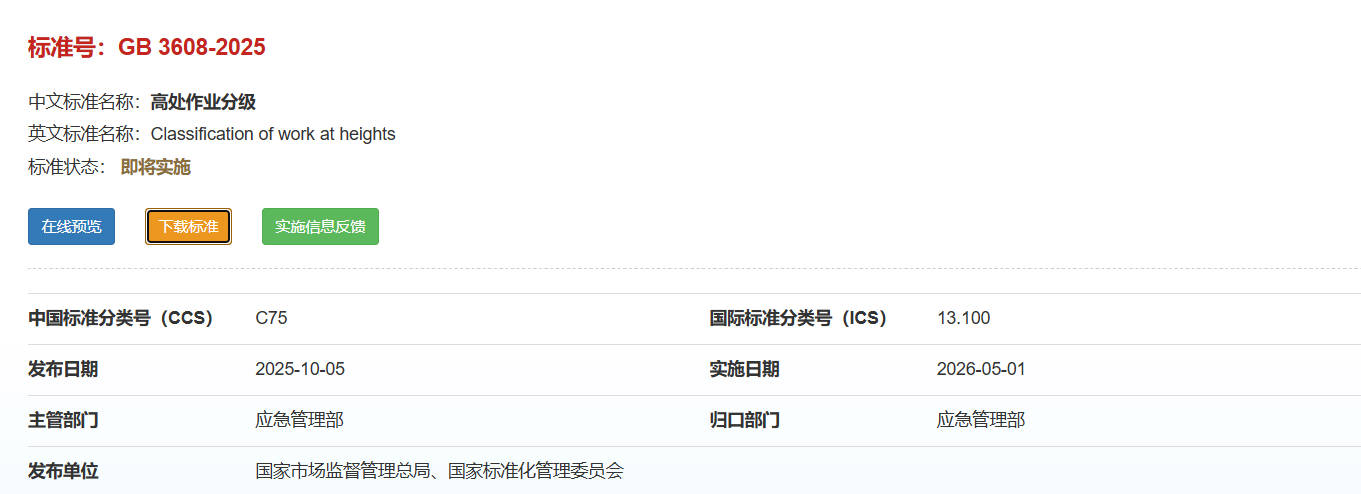
1. Core Changes: From "Height Assessment" to "Risk Assessment"
| Dimension | GB/T3608-2008 (Previous) | GB3608-2025 (New) |
|---|---|---|
| Assessment Scope | Height only (2-meter threshold) | Comprehensive assessment: height + environment + personnel + work method |
| Protection Logic | Height compliance → basic protection | Presence of fall risk → systematic protection |
| Equipment Requirements | Safety belt configuration sufficient | Establish complete fall prevention system |
| Inspection Rigor | Relatively lenient | Full-process, multi-dimensional review |
2. Three Direct Impacts
Impact 1: Height is no longer the sole measurement standard
Historical management was straightforward: protect work above 2 meters, largely ignore work below 2 meters.
The new standard eliminates this boundary. Even if work height is below 2 meters, if fall risk exists (such as on slopes, at openings, or in cross-work environments), high-altitude work standards must apply. This requires enterprises to reassess site "hidden risks."
Impact 2: New dimensions of risk assessment
The following factors directly elevate work risk classification and trigger stricter protection requirements:
Severe weather (high winds, heavy rain)
Insufficient lighting (nighttime or low indoor illumination)
Extreme temperature environments
Multi-person cross-work operations
Proximity to high-voltage equipment
Operators with insufficient experience or compromised physical condition (hypertension, acrophobia, etc.)
Impact 3: "Fall Prevention System" replaces single-point equipment
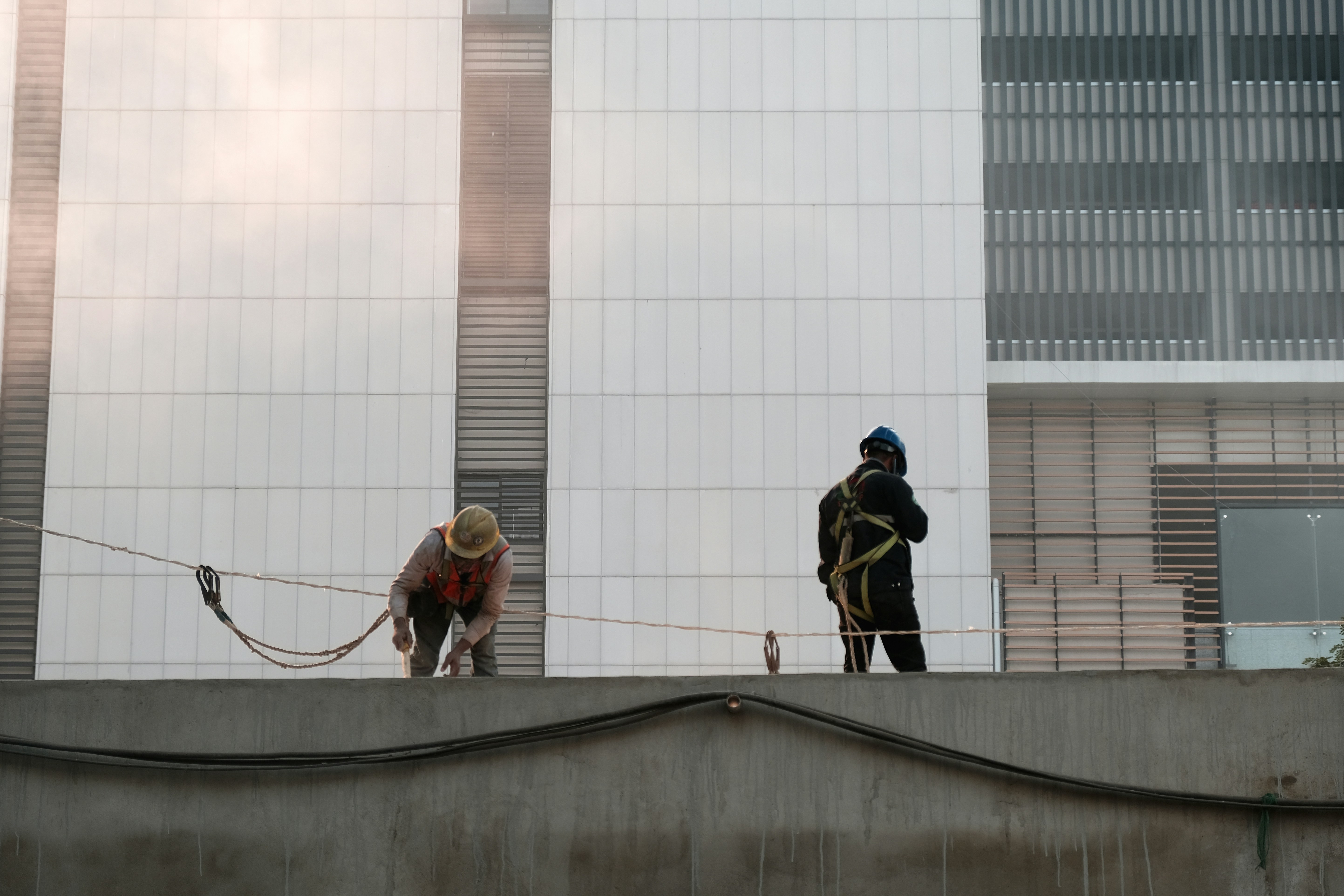
This is the most fundamental change. The new standard no longer accepts that "equipping employees with safety belts ensures safety." It requires establishing a complete fall prevention closed-loop:
✓ Reliable fixed anchor points
✓ Continuously effective attachment solutions
✓ On-site dedicated supervision
✓ Fall pathway risk identification and control
In other words, the safety belt is only part of the system, not the whole.
3. Three Directions Requiring Immediate Enterprise Adjustment
Direction 1: Pre-work risk assessment becomes mandatory process
Before work commences, the following must be completed: develop specialized plans, clarify fall risk points, rather than addressing issues reactively after work begins. This requires:
Environmental survey and documentation
Personnel capability assessment
Weather and time condition evaluation
Emergency response plan preparation
Direction 2: Protection upgrades from "provision" to "system"
Re-examine your site protection plan:
Anchor point reliability: Can existing attachment points withstand fall impact?
Continuous protection: Are employees protected throughout the entire work process?
Personnel configuration: Is a safety monitor assigned?
Equipment compatibility: Are safety belts, ropes, and absorption devices mutually compatible?
Direction 3: Comprehensive management system enhancement
Prepare for stricter approvals, more frequent inspections, and higher penalty costs. This requires:
Establish high-altitude work management manual
Train management and operational personnel
Establish routine inspection and equipment maintenance procedures
Document all work activities
4. Four Most Common Pitfalls
❌ Pitfall 1: Masking "high risk" with "low height"
Misconception: Work below 2 meters requires no protection.
Reality: Low-level work on slopes, at open edges, or on mobile platforms carries equally fatal fall risks.
❌ Pitfall 2: Treating safety belt as complete protection
Misconception: Employees wearing safety belts are safe.
Reality: Without reliable anchor points, supervision, or fall pathway control, safety belts are ineffective.
❌ Pitfall 3: Ignoring compounded risk
The following combinations are the most common site "risk bombs":
Nighttime work + high altitude = reduced visibility + impaired judgment
Cross-work + high altitude = personnel density + mutual interference
New employees + high altitude = lack of experience + weak emergency response capability
❌ Pitfall 4: Compliance inspection theater rather than genuine protection
Some enterprises conduct temporary corrections before inspections only to revert afterward. The new standard increases inspection frequency and depth significantly—this approach carries extreme risk.
Conclusion
The implementation of GB3608-2025 fundamentally represents an upgrade in requirements for "systematic protection." It is not merely a technical standard update, but a deepening of safety management philosophy—transitioning from reactive "post-incident remediation" to proactive "pre-event prevention."
Standard upgrade requires enterprises to improve protection management systems. If you require professional support in system assessment, equipment testing, or employee training, now represents your final preparation window.